led by NT Countryside Manager, James Roden
24th July 2025
The group met at Cilau Ganol farm, where Jane Mason, PNTA Chair, gave a brief introduction to the current activities of the PNTA, before introducing James Roden who led the interpretive walk.
Ten of the group were local residents from Llanwnda, the adjacent hamlet, who were keen to find out the NT’s plans for the farm. They had enthusiastically joined PNTA, prior to the walk.
James explained that the NT had bought the farm holding in 2024, as it had come on the market and provided an opportunity to join up existing NT ownerships on both side of Cilau Ganol, thus enabling a more holistic management regime for the three contiguous parcels of land. Prior to the sale the previous farmer had conducted an organic dairy business.
The three Cilau farms had historically been farmed by local families, probably going back as far as mediaeval times. The original Cilau Ganol farmhouse had been sold off separately many years ago and is in private ownership. Since the NT took over the Cilau Ganol site, the various slurry tanks have been removed and the worst of the farm sheds, demolished. The modern bungalow is being extensively refurbished for rental. A wall will be built at the lower edge of the farmyard and the remaining sheds may be made available for rental by other farmers.
James stressed that the main aspiration for the future of the farm would be to move gradually to a more nature-friendly land management regime, reducing the nutrient levels in the soil and moving to farm in a less intensive manner. In due course, a farm tenant would probably be sought, to operate the farm in accordance with NT conservation policies.
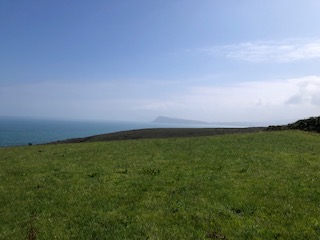
Photograph Jane Mason
Walking on through the fields, down towards the coast path, James explained how the high “nutrient load” existing within the fields’ soils would be gradually reduced by taking off successive crops of hay and allowing the dormant native plants to flourish and re-establish. This would be a slow process, (over several years), because, although the dairy regime had been organic, slurry had been regularly spread, and some nutrient build-up within the regolith had inevitably occurred. Artificial fertilisers had probably not been used by the previous farmer, but the use of slurry would have taken effect on the nitrogen levels in the soils. Grazing by ponies was one remedial option, as they can help to encourage desirable native plants to re-emerge. The joining up of the adjacent landholdings would facilitate grazing over a wider area, possibly removing some existing fences and using “virtual fences” as currently being executed at NT Southwood, near Newgale.
Photograph Jane Mason
James pointed out the moorland on the adjacent NT land to the SE, indicating the need for the ecological management of that habitat to be kept free of unwanted nutrients, another reason for the Cilau Ganol purchase.
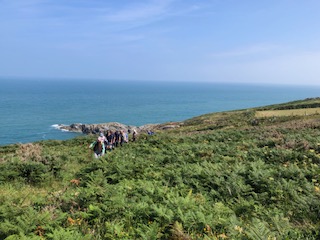
The group walked on downslope to join the Coast Path, where we admired the views towards Dinas Island and along the coast, some of the early mist having dissipated by this time. James explained that the route we had followed so far was not open for public access, but that the remainder of the walk would be on the Coast Path and on another route which he was hoping to open up to replace a very wet permissive path back to the farm, which currently exists. More new footpaths across the farm may be introduced in due course.

PNTA Members with James Roden, lead Ranger. Photograph Jane Mason
Upon returning to the farmyard, James answered many questions and was warmly thanked for his detailed explanations and enthusiastic delivery of the walk/talk.
Steve Drinkwater
25 July 2025
 Pembrokeshire National Trust Association