After the usual introductions, Colby Head Gardener, Steve Whitehead, led us on a fascinating tour of the woodland garden.

Photograph Jane Mason
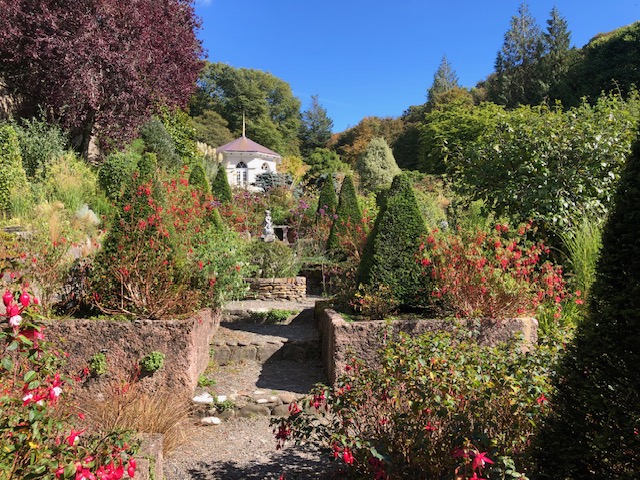
Starting in the Walled Garden, he described the restoration of the gazebo which had entailed the complete replacement of the roof after various swarms of honeybees had been humanely removed. More needs to be done to restore the paintings inside, but this will be dependent on future fundraising efforts.
A huge Magnolia was commented on, which Steve explained had exhibited an erratic flowering pattern over several years, a few flowers being visible now.
The walled garden has a mild, sheltered microclimate which enables some species to thrive which could not be grown in other parts of the gardens. The corollary of that had been exhibited some years ago by a number of mulberry trees, which had been planted, dying off. Even replacement mulberries had perished. The location has proved unsuitable for the mulberry.
Photograph Jane Mason
Moving into the meadow, Steve talked in detail about the oak trees in the valley, most of which are sessile oak and thus provide habitats for many hundreds of other species. Storm Darragh had wreaked havoc across the site, demolishing and uprooting many fine trees and blocking the access road. Fortunately, very few oaks had suffered but many other trees had been destroyed. The many oak trees present massively influence the ecosystem in the valley and thus are key to the success of the NT’s management of the site. Colby, like many other woodland sites, is fighting a whole series of tree diseases (e.g. oak, larch) which have infiltrated due to climate change. However, there are ways to adapt, such as bringing in resistant species from New Zealand. Larch are progressively being cleared from the E side of the valley, allowing the small colony of native wild service trees to survive and thrive.
Colby provides a refuge for many species of plants and animals which are becoming extinct elsewhere. This includes a number of tree species and 14 species of bats, including a barbastelle roost which was found in a survey conducted by the Vincent Wildlife Trust.
Bamboo is a potentially invasive species down by the stream and Steve explained that large amounts of soil had had to be excavated and removed in order to eradicate bamboo and attempt to confine it to a small area. Even so, some of it is recolonising along the stream bank.
He talked about the history of coal mining in the valley and pointed out the remains of the winding gear which were displayed alongside one of the (now capped) mineshaft.
Scots Pine was visible nearby and Steve told us how they lose their lower branches as they grow ever upwards towards the light.
Wildflower meadow management was another topic which Steve discussed in some detail – they operate a rotation of the mowing regime to allow wildflower seeds to settle, also yellow rattle is used extensively to try to out-compete the more vigorous grasses, which would otherwise throttle the wildflower species in time.
Steve explained how dependent he is on volunteers, as the very small number of paid staff simply could not manage the workload without the volunteers’ help. He also expressed his gratitude to the PNTA for a number of funding grants to Colby over many years.
In conclusion, the Chairman, Jane Mason, conveyed our thanks to Steve Whitehead for a very detailed and illuminating interpretive walk and there was a spontaneous round of applause from the group before people headed off to the tea room for refreshments.
Steve Drinkwater
22 September 2025
 Pembrokeshire National Trust Association