Melanie Knapp & Mair Coombes Davies
Photographer by Andrew Weaver
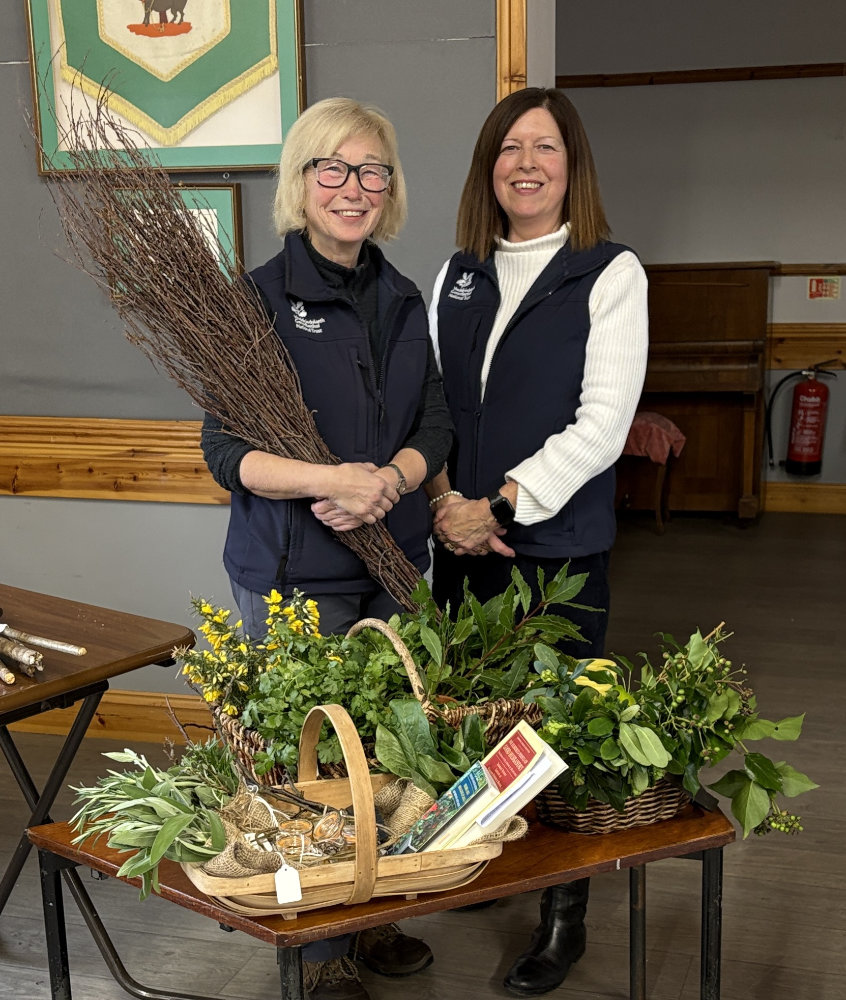
Mair and Melanie with a selection of items, many from the garden , used as food, herbal remedies or cleaning agents
The theme of the talk was based on “A conversation between the house team exploring some of the first feast days in January and February, looking at three elements on what would be involved in the house now and in the Tudor period. Namely cleaning, preparation of food for the feast and health following overindulgence”
Melanie and Mair had brought along a collection of items to support the talk. These included a copy of ‘The National Trust Manual of Housekeeping’ and ‘500 Points of Good Husbandry’ by Thomas Tusser (a practical guide to agriculture and household management written inthe late 16th century). A selection of plants from the garden were used as examples to give explanations about their medicinal, culinary, or domestic purpose.
Mair told about herbs, plant-based remedies and their applications. The following are given as examples: Lavender served multiple purposes in the household. It was valued for its ability to mask unpleasant odours, repel insects, add flavour to food, and assist in treating illnesses. Bay leaf, a commonly used aromatic herb, featured regularly in pottage and was often combined with parsley, sage, rosemary, and thyme to enhance flavour and provide health benefits. Flag iris was used to alleviate toothache, while nettle ointment served as an anti-inflammatory treatment for stiff limbs. Liver wart assisted in healing burns and scalds, and Alexanders helped to warm a cold stomach. Beetroot and saffron were natural colouring agents. Tannin, extracted from certain plants, was utilised as the foundation for making ink.
Household cleaning tasks included sweeping floors and cleaning windows. We were shown a traditional broom crafted from birch twigs bound to a handle with bark. The broom’s flexible and springy construction, along with its rounded shape, made it particularly effective for sweeping uneven surfaces. For removal of mould, a solution ofethanol and water was applied. Vinegar was a versatile substance, used for general cleaning, culinary purposes, and hygiene. Bug-related issues were addressed by washing linen thoroughly. Soap bars were made from tallow, and occasionally, charcoal was added to produce black soap.
Artificial illumination was provided by beeswax candles, which could be straight or coiled. These candles burned cleanly and emitted a pleasant fragrance. In less affluent households, tallow candles were used instead. Wicks, reeds, and mullein stalks also served as lighting materials, although they were associated with bacteria and dirt resulting from smoke residue. Starch was produced from the roots of Bluebell or Cuckoo pint. The merchant’s house was renowned for offering quality food on all occasions. Fish was often chosen over meat, with porpoise served alongside parsley sauce. Flat leaf parsley was preferred to round leaf parsley due to its benefits for indigestion. Oysters were sourced from the west bank of Caldey, and almonds were imported. Additionally, Tenbywas notable for being the first to record a cargo of oranges.
Report by Graham Wright
 Pembrokeshire National Trust Association