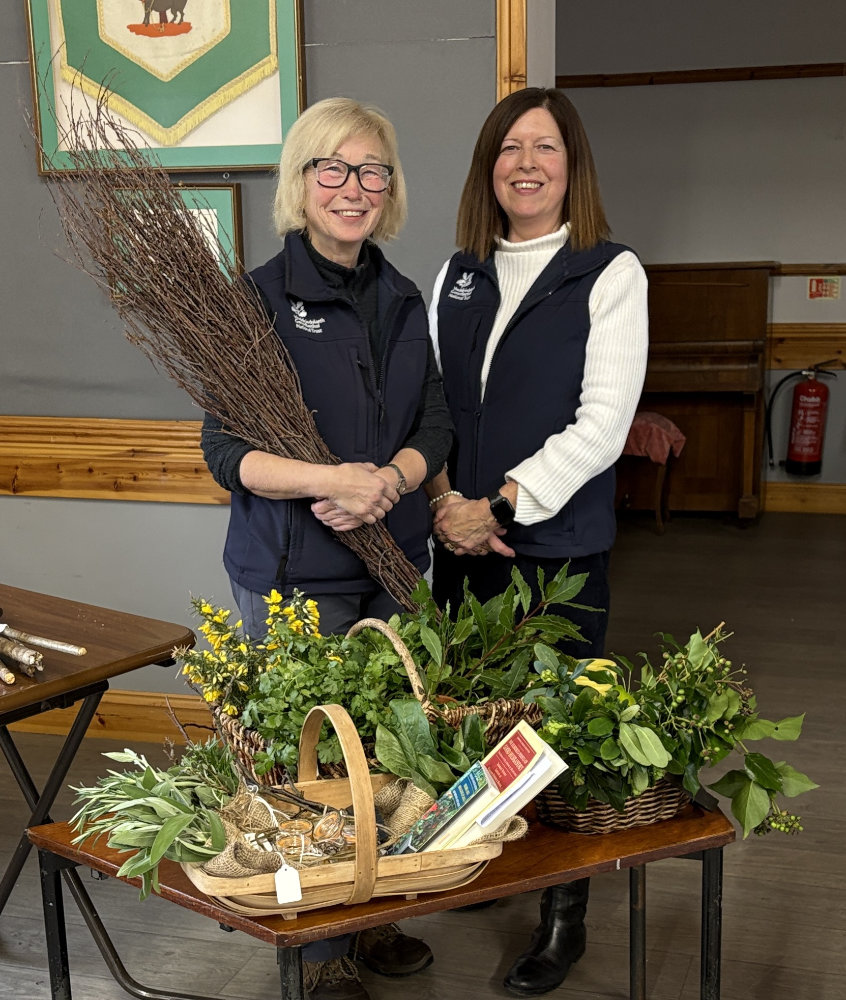
Mair and Melanie with a selection of items, many from the garden , used as food, herbal remedies or cleaning agents
The theme of the talk was based on “A conversation between the house team exploring some of the first feast days in January and February, looking at three elements on what would be involved in the house now and in the Tudor period. Namely cleaning, preparation of food for the feast and health following overindulgence”
Melanie and Mair had brought along a collection of items to support the talk. These included a copy of ‘The National Trust Manual of Housekeeping’ and ‘500 Points of Good Husbandry’ by Thomas Tusser (a practical guide to agriculture and household management written inthe late 16th century). A selection of plants from the garden were used as examples to give explanations about their medicinal, culinary, or domestic purpose.
Mair told about herbs, plant-based remedies and their applications. The following are given as examples: Lavender served multiple purposes in the household. It was valued for its ability to mask unpleasant odours, repel insects, add flavour to food, and assist in treating illnesses. Bay leaf, a commonly used aromatic herb, featured regularly in pottage and was often combined with parsley, sage, rosemary, and thyme to enhance flavour and provide health benefits. Flag iris was used to alleviate toothache, while nettle ointment served as an anti-inflammatory treatment for stiff limbs. Liver wart assisted in healing burns and scalds, and Alexanders helped to warm a cold stomach. Beetroot and saffron were natural colouring agents. Tannin, extracted from certain plants, was utilised as the foundation for making ink.
Household cleaning tasks included sweeping floors and cleaning windows. We were shown a traditional broom crafted from birch twigs bound to a handle with bark. The broom’s flexible and springy construction, along with its rounded shape, made it particularly effective for sweeping uneven surfaces. For removal of mould, a solution ofethanol and water was applied. Vinegar was a versatile substance, used for general cleaning, culinary purposes, and hygiene. Bug-related issues were addressed by washing linen thoroughly. Soap bars were made from tallow, and occasionally, charcoal was added to produce black soap.
Artificial illumination was provided by beeswax candles, which could be straight or coiled. These candles burned cleanly and emitted a pleasant fragrance. In less affluent households, tallow candles were used instead. Wicks, reeds, and mullein stalks also served as lighting materials, although they were associated with bacteria and dirt resulting from smoke residue. Starch was produced from the roots of Bluebell or Cuckoo pint. The merchant’s house was renowned for offering quality food on all occasions. Fish was often chosen over meat, with porpoise served alongside parsley sauce. Flat leaf parsley was preferred to round leaf parsley due to its benefits for indigestion. Oysters were sourced from the west bank of Caldey, and almonds were imported. Additionally, Tenbywas notable for being the first to record a cargo of oranges.
Angela has enjoyed a long career in education, complemented by a longstanding passion for history, literature, and heritage. As a dedicated volunteer at the Tudor Merchant’s House in Tenby, she has contributed significantly to preserving and interpreting local history. Her work in historical settings has enabled her to blend storytelling, education, and community engagement effectively.
During her recent talk on Gumfreston, Angela set the scene and introduced the area with historical pictures, maps and the phrase, “the world forgotten by the world forgot.” Situated in a wooded valley above the river Ritec, Gumfreston was historically significant as a stop for pilgrims travelling to St Davids and may have also attracted smugglers. The site’s origins predate the church, with evidence of Roman and Celtic worship, including a distinctive round churchyard.
The Church of St Lawrence, located near three holy wells reputed for their healing properties, was central to village life and even supported local sporting traditions, such as cockfighting. The belfry of the church houses what is believed to be the oldest bell in the county. Although the church fell into ruin, it has since been restored by the Friends of Friendless Churches, revealing medieval wall paintings and other historical features.
Angela also highlighted notable figures associated with Gumfreston, including Rev Smith, a rector known for his work as a beekeeper, antiquary, archaeologist, and geologist. His collection became foundational to the Tenby Museum. Other notable connections include Benjamon Hall (linked to Big Ben and the Elizabeth Tower), Edwin William John (father of Augustus and Gwen John), and the site of a historic duel between William Richards and John Owen. The Perrot family were once associated with nearby Scotsborough manor, which was abandoned following a smallpox outbreak and remains in total ruin.
Angela’s talk was interesting and demonstrated the enduring historical and cultural significance of this often-overlooked village. After the talk Jane showed a short video which complemented the talk and introduced the renovation work done by Friends of Friendless Churches.
Linda Asman is Chair of the Pembroke & Monkton Local History Society, a registered charity which aims to research and raise awareness of the heritage of Pembroke and district. During the talk Linda spoke about the projects and achievements of the Society since its inception in 2010.
Initially the Society prioritised the creation of a photographic and oral history archive, which was subsequently published as a DVD with accompanying book. Then, in 2013, Pembroke Town Council set up its Regeneration Committee to bring together local organisations to work on projects to enhance the town. Linda described how this was the catalyst for more ambitious projects. The History Society took a leading part in developing a Town Trail (with Pembroke Civic Trust), a Digital Town Trail and most ambitions of all, a statue of Pembroke’s most famous son, Henry VII which was unveiled in 2017. The Society took this forward with a further statue of William Marshal unveiled in 2022 and is working on plans to develop a statue trail, working closely with the Town Council and community.
The Society is also very proud of its role in the setting up of a museum in Pembroke’s Town Hall. Society volunteers have developed the museum from scratch on an entirely voluntary basis, so successfully that it has recently been awarded full accreditation status. Some interesting insights were given i.e. fund raising with a miniature figure of Henry VII, using a local sculptor (Harriet Addyman) and the three future statues of women, Nest, Margaret and Isabel. Linda showed that combined aspects of art, heritage and the natural environment are splendidly displayed by means of the statues, castle, walks, and millpond. Information regarding the projects mentioned in the talk may be found by visiting the following link Projects. https://www.pembrokeandmonktonhistory.org.uk/Projects.html
Nicola Davies is a zoologist and author of over 80 children’s books, mainly focused on the natural world. Her books have been translated into more than 12 languages and have won awards in the UK, Japan, America, Germany, and France. The novel ‘Skrimsli’ won the Wales Book of the Year (children and young people’s category) in 2024. She is a Professor of Practice at the University of Wales, School of Illustration in Swansea, and lives near Solva. From September 2025, she is the new Children’s Laureate for Wales.
Nicola was a presenter on the BBC’s ‘The Really Wild Show’ and has studied species such as bats, turtles, sharks, and whales. She aims to communicate the wonder of the natural world and emphasizes the importance of children’s connection with nature.
Using imagination, illustration, storytelling, information and humour, in her books she engages with different age children
‘Surprising Sharks’ was highlighted as an example of an informative picture book that uses illustrations and playful storytelling to teach children about sharks. In the book she flips perspective, showing that humans are a greater threat to sharks than vice versa.
Use of an interesting and unusual book title may attract different audiences (e.g., ‘Poo’, ‘What’s Eating You’, ‘Animals Behaving Badly’).
Fantasy fiction is employed to address complex topics like climate change, politics, and greed, making them acceptable to children without causing distress.
Nicola has a lifelong love of poetry and uses it to convey information succinctly.
The talk was concluded by reinforcing the theme of appreciating the wonder of the natural world.
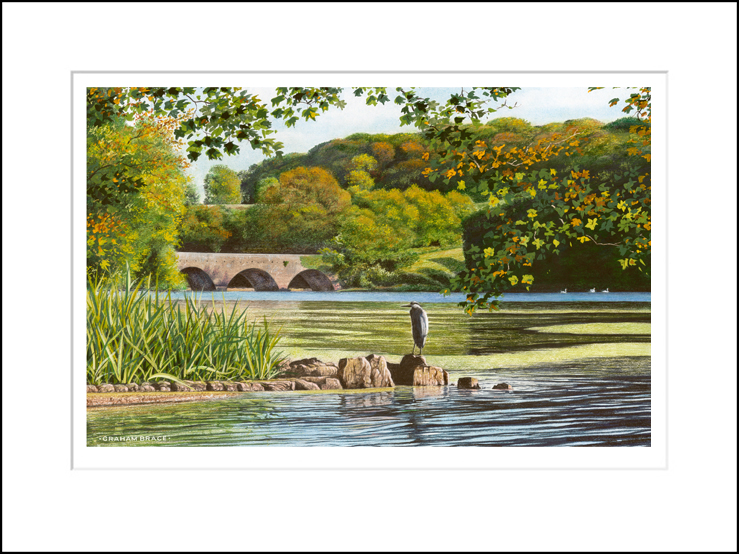
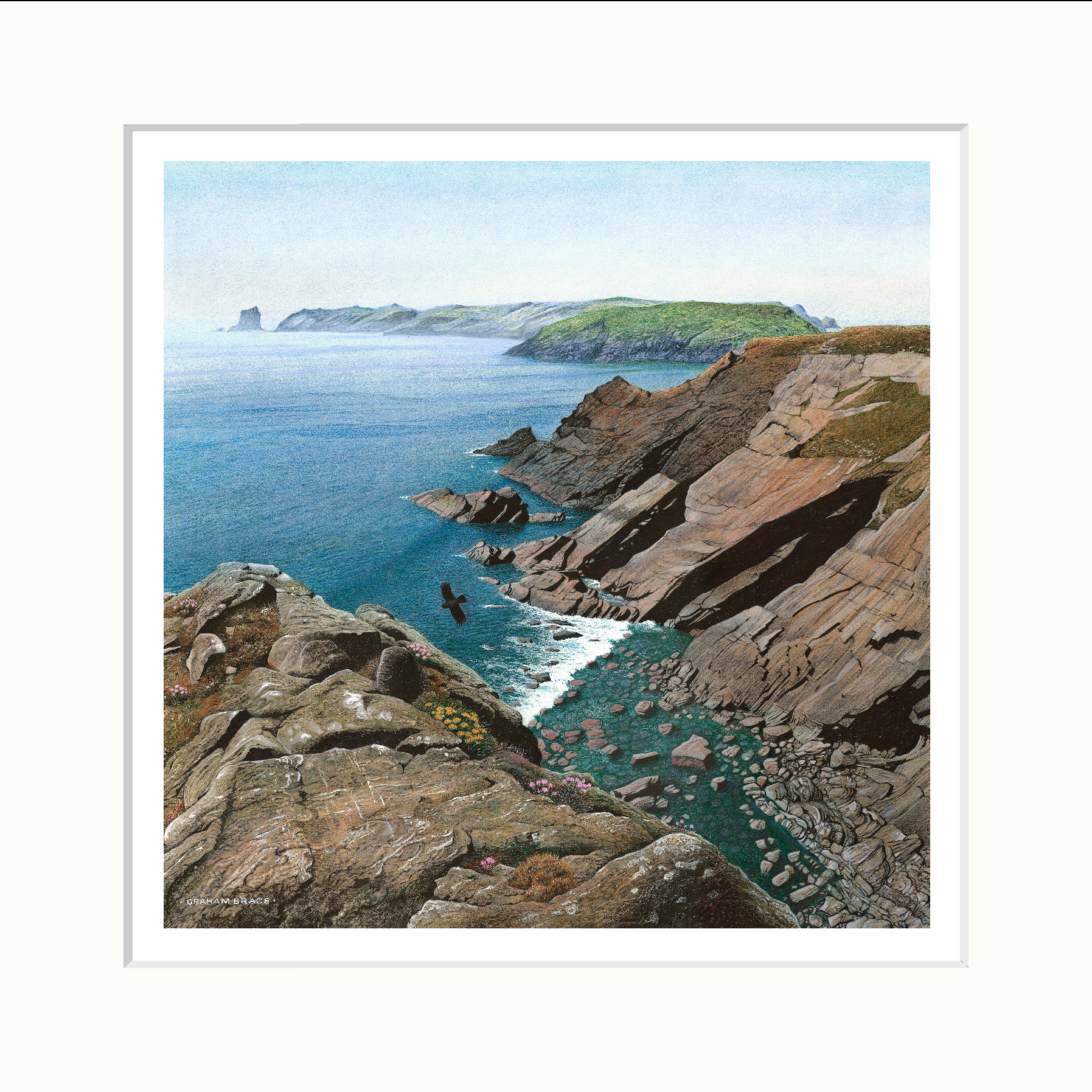
Artist and PNTA member, Graham Brace, on a recent visit to Stackpole came up with the idea of selling signed and numbered, limited edition mounted prints of paintings he has done over the years, in National Trust areas in Pembrokeshire. These prints are offered exclusively to PNTA members at a greatly reduced price of £50 each – (normally retailing at £90).
A donation of £15 will be made to the PNTA from each print sold. The subjects shown here are…
Heron Sentry at Bosherston
Marloes and Gateholm
Skomer from the Deer Park, Marloes Peninsula
The view to Wooltack Point, Marloes Peninsula
Full details are on the Order Form. If you would like to purchase a print please download the order form, complete it and return to Graham or complete it on your computer and return to grahambrace@btinternet.com
PNTA members at the AGM and Pre Christmas Lunch. Photograph Andrew Weaver
Minutes and Treasurer’s report were approved.
Jane Mason, Andrew Weaver, Annie Weaver, Marilyn James and Steven Flather have been on the committee for more than five years. They were duly re-elected after ten signatures were obtained from PNTA members.
Lyn Humphries, Graham and Sandra Wright were also re-elected. Positions remain as previously.
Jonathan Hughes, Assistant Director for Wales, gave a talk following lunch about his new role as lead for Restoring Nature for the National Trust across Wales. He explained the National Trust is establishing three main themes of work and this is one. The others being visitor growth, and access including a new focus on The Valleys. His aim is to work on large scale projects such as restoring peat bogs, expanding and creating new deciduous forests, and restoring biodiversity in Wales. In the face of a nature emergency and climate change we need to work fast to really make a difference to nature recovery in the next ten years. This work will include partnering and working with many other large organisations and grant funders to make these large projects happen.
Chairman’s report
Welcome to everyone including Jonathan Hughes, Assistant Director of Operations South Wales and thank you all for braving the snow…
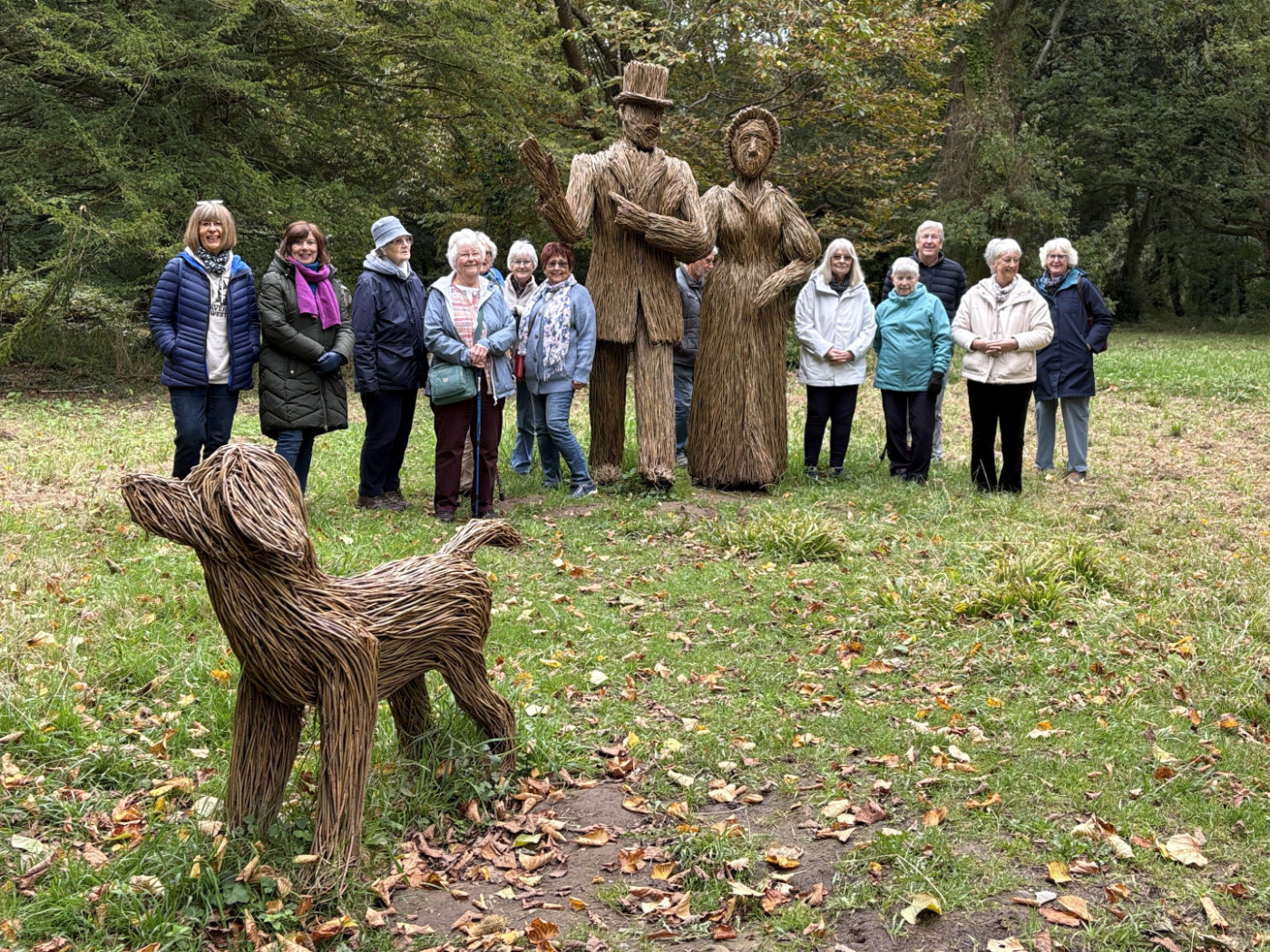
In 2025 I have once again been delighted by the work and enthusiasm of the committee and the friendliness and support of the PNTA membership. This must be the year of the willow sculptures which the PNTA donated to Stackpole. Who would have known that this Victorian couple and the spaniel could have caused such a social media stir.
The year has seen a huge variety of walks and talks. The winter 2024/2025 talks were organised by myself and kindly aided in admin and sound by committee members Sandra and Graham Wright and Alan Mason off committee. From Cesar Picton to historical figure of Tenby, National Trust woodlands and maritime archaeology around the Pembrokeshire coast we always learn something new. An interesting 2025/26 programme is now being entirely organised and run by Graham and Sandra Wright who I am very grateful to for taking this over from me. They are looking ahead to 2026/27, so ideas and comments always welcome.
I always look forward to our lovely summer walks programme, well organised by Steve Drinkwater. These included the Port of Haverfordwest, Regeneration work at the newly acquired NT farm Cilau Ganol in North Pembrokeshire and a stroll through stunning Colby woodland garden. All in glorious sunshine.
The Summer day visits proved popular with a visit to the Gwili railway and a coach trip to llanelly house. Thank you to Graham Brace for making these happen.
A highly successful annual tour, this year in May to North Wales, saw 51 people enjoying the delights of Penrhyn and Caernarfon castles, Conway, Bodnant and the osprey centre. Thanks to all who joined the tour, helping to raise funds for PNTA and to Annie and Andrew Weaver for their amazing organisation and friendly welcome. Next year the tour hits south Devon on the 10-14 May, there are some spaces left so do talk to us if interested.
We also had two lovely get togethers at Hilton and the walled gardens kindly organised by Lyn Humphreys.
During the year members received two excellent and informative newsletters, stoically collated and produced by Marilyn and a monthly newsy mailchimp diligently put together by Andrew
How lucky we are to get all this for just £5 a year or £8 couple – and the price has not gone up!
Subscriptions are due by January for 2026 and everyone needs to fill in a new style membership form. This is downloadable from the website or available here or at meetings. All newsletters will now be sent electronically unless you specifically ask for a printed copy at the additional cost of £2 to be paid to our Treasurer.
Sadly, we had two resignations from the committee a couple of months ago – Sheila Ashton after more than 10 excellent years as Membership Secretary. This year she kindly worked with me on trying to get our database reconciled. Graham Brace has organised two summers of great day trips. So, our thanks go to them both. Without people helping in this way the PNTA would not exist.
I am holding the fort as Membership Secretary, so a big plea for you all to make sure you get your forms and payments sorted. I know many pay by standing order but please fill in the new form. We have fortunately been lucky to recruit Angela Probert Jones to the role as Membership Secretary from February 2026 onwards. That leaves a vacant committee position to organise summer day trips. Please talk to me if you think you can be of help for one or more trips, on or off committee
I have recently met with Rhian Sula, General Manager NT Pembrokeshire, who explained the change process that is going at the Pembrokeshire National Trust regarding area organisation and staffing. We will know more by February who our main contacts there will be. She again expressed her gratitude to all in the PNTA for your help and donations. We will be working together to look at ways to recruit new members and support the Stackpole Estate as they celebrate their 50 years under the NT in 2026.
Our membership is currently 261. Please ideas and suggestions to attract new members are always welcome…. We have had a suggestion of a gift membership but are considering how to administer this. Don’t forget we have this year produced a leaflet about ourselves and if you need any of these or a poster to promote the PNTA to friends or your community do ask for copies.
Our PNTA funds remain healthy and thanks to our Treasurer Steven for all his work behind the scenes keeping the accounts and the money in order. The accounts were circulated and approved.
In a recent report to our committee, our Treasurer Steven explained that at the End October the Association shows a net worth £12,087,97
I can announce today that the PNTA committee has just agreed this week to donate £3460 to the Pembrokeshire National Trust: Stackpole rose arch renovations and new and path edging, oak tree planting – Sessile oaks for planting at Southwood and Abermawr, a new bookcase for the Colby gardens second-hand bookshop, two voice recorders to collect oral history memoirs, willow baskets and pottery for Colby and water sampling at Broad Haven South to be able to provide drinking water supplies.
The committee will be also considering sponsoring a project or event linked to the 50th anniversary celebrations at Stackpole next year. if there are no objections to this today, we consider these as accepted by PNTA members.
Thanks to Annie Weaver for her diligent role as Secretary and organising today’s event and of course to all the committee and PNTA members for their support in 2025.
Ant Rogers, Biodiversity Implementation Officer for Pembrokeshire Nature Partnership
Ant Rogers has worked in environmental protection and nature recovery in various roles since 1996. For the last 13 years he has been the Biodiversity Implementation Officer for the Pembrokeshire Nature Partnership – promoting collaboration to deliver nature recovery actions across the County and beyond. Ant’s briefing covered the state and role of nature in the global, national and local context; why that mattes to our society; and what we can do to promote nature recovery. Ant’s role helps bring together and co-ordinates different organisations. This includes the National Trust with whom he has conducted lichen surveys.
Ant explained why nature matters and why healthy functioning ecosystems sustain life on earth and provide services that underpin society. It should be accepted that our economies are embedded within nature, not external to it. The ‘World Economic Forum Global Risks Report’ shows five categories: economic, environmental, geopolitical, societal and technological. In terms of Global Risks regarding their likelihood and impact, many are environmental. For instance, climate action failure, extreme weather and biodiversity loss.
From the data a further two lists, short term (2 years) and longer (10 years), are compiled which indicate the top ten impacts of risks. Biodiversity is not seen as a pressing concern in the short term, but is in the longer term. Estimates are that over half of the world’s economic output rely on nature. Collapse of natural ecosystems may have severe consequences. The result could be seen as reduction of crop yields and pollination. Also, the supply and quality of water could be affected!
Some key facts were given from the ‘2023 State of Nature Report (Wales)’: Since 1994 Welsh wildlife has decreased on average by 20%. Moths indicate strongest decline and one in six Welsh species are threatened with extinction. Plant species are found in fewer places than before. The reasons for decline are due to the way land is managed for industry, agriculture and for the changes in freshwater. Climate change and invasive species also have an impact.
A ‘Nature recovery action plan’ exists in Pembrokeshire, the purpose of which is to educate and raise public awareness through events and newsletters. It also works with public bodies, the private sector, special interest groups, communities and landowners. The following two examples were given: Example 1. Households in Spittal were given a packet of native wildflower seeds to plant and encourage feeding of invertebrates and birds. Example 2. Partnership of local council, fire service, health authority working together to install nesting boxes on side of a hospital owned building.
Safeguarding species and management of habitats is a priority. Where space is available, wildflower beds are created to encourage pollinating and wildlife.
Ant stressed that we should all be involved and signposted us to some initiatives such as B- Lines and Bee Friendly. B-Lines is a series of ‘insect pathways’ running through our countryside and towns, along which we are restoring and creating a series of wildflower-rich areas.
‘Bee friendly’ aims to provide pollinators with food sources, places to live and the avoidance of harmful pesticides and herbicides.
For more information please use the following textual links. Report by Graham Wright
Over 20 of us met for coffee in the Mencap cafe. We’d hoped for sunshine and sitting outside but the weather was a little chilly. However, there was room inside for all of us.
A good number of us set off walking, past the crocodile and into the Sensory garden. We looked at the very old seed drill and walked through to the other vineyard. Fiona told us a bit about the vines. In the meadow by the rose arch, Annie and Andrew gave us some information re the trees and Magnolias. From there we meandered through to the Willow sculptures and on to the Court. After looking at the remaining buildings, some of us walked to the 8 arch bridge and others back along the road, to meet up again for a very pleasant lunch!
The Willow Figures at Stackpole. Photograph Andrew Weaver
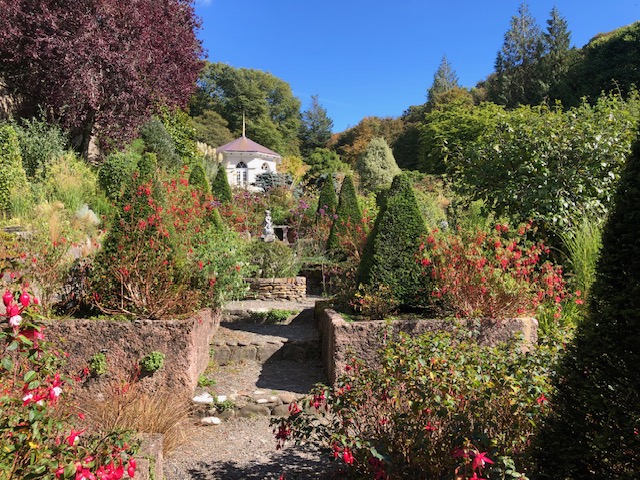
After the usual introductions, Colby Head Gardener, Steve Whitehead, led us on a fascinating tour of the woodland garden.
Photograph Jane Mason
Starting in the Walled Garden, he described the restoration of the gazebo which had entailed the complete replacement of the roof after various swarms of honeybees had been humanely removed. More needs to be done to restore the paintings inside, but this will be dependent on future fundraising efforts.
A huge Magnolia was commented on, which Steve explained had exhibited an erratic flowering pattern over several years, a few flowers being visible now.
The walled garden has a mild, sheltered microclimate which enables some species to thrive which could not be grown in other parts of the gardens. The corollary of that had been exhibited some years ago by a number of mulberry trees, which had been planted, dying off. Even replacement mulberries had perished. The location has proved unsuitable for the mulberry.
Photograph Jane Mason
Moving into the meadow, Steve talked in detail about the oak trees in the valley, most of which are sessile oak and thus provide habitats for many hundreds of other species. Storm Darragh had wreaked havoc across the site, demolishing and uprooting many fine trees and blocking the access road. Fortunately, very few oaks had suffered but many other trees had been destroyed. The many oak trees present massively influence the ecosystem in the valley and thus are key to the success of the NT’s management of the site. Colby, like many other woodland sites, is fighting a whole series of tree diseases (e.g. oak, larch) which have infiltrated due to climate change. However, there are ways to adapt, such as bringing in resistant species from New Zealand. Larch are progressively being cleared from the E side of the valley, allowing the small colony of native wild service trees to survive and thrive.
Colby provides a refuge for many species of plants and animals which are becoming extinct elsewhere. This includes a number of tree species and 14 species of bats, including a barbastelle roost which was found in a survey conducted by the Vincent Wildlife Trust.
Bamboo is a potentially invasive species down by the stream and Steve explained that large amounts of soil had had to be excavated and removed in order to eradicate bamboo and attempt to confine it to a small area. Even so, some of it is recolonising along the stream bank.
He talked about the history of coal mining in the valley and pointed out the remains of the winding gear which were displayed alongside one of the (now capped) mineshaft.
Scots Pine was visible nearby and Steve told us how they lose their lower branches as they grow ever upwards towards the light.
Wildflower meadow management was another topic which Steve discussed in some detail – they operate a rotation of the mowing regime to allow wildflower seeds to settle, also yellow rattle is used extensively to try to out-compete the more vigorous grasses, which would otherwise throttle the wildflower species in time.
Steve explained how dependent he is on volunteers, as the very small number of paid staff simply could not manage the workload without the volunteers’ help. He also expressed his gratitude to the PNTA for a number of funding grants to Colby over many years.
In conclusion, the Chairman, Jane Mason, conveyed our thanks to Steve Whitehead for a very detailed and illuminating interpretive walk and there was a spontaneous round of applause from the group before people headed off to the tea room for refreshments.





 Pembrokeshire National Trust Association